Where does tax go once it leaves your payslip? This calculator shows exactly how your income tax and National Insurance is split between welfare, the NHS, State Pensions, debt interest, schools and more. Enter your salary or your tax bill, and see it broken down in pounds using the same official figures HMRC uses in your Annual Tax Summary.
How to use the where does tax go calculator
The calculator works on a phone or a laptop. Here is how to get the most from it.
Step 1: Choose how to start
Pick Enter my salary to let the calculator work out your tax for 2026/27. Alternatively, pick I know my tax bill and type in the total from your payslips or tax summary.
Step 2: Enter your number
Type your yearly salary or tax bill. The breakdown updates straight away.
Step 3: Read your breakdown
Each bar shows how much of your tax goes on one area, in pounds and as a share. The biggest areas are at the top.
Step 4: Check the surprise fact
Under the bars you can see how much of your tax goes on interest on the national debt, compared with defence and transport.
What your tax pays for: the big five
Five areas take about three quarters of the money in HMRC’s breakdown. These figures are for 2024/25, the latest year HMRC has used.
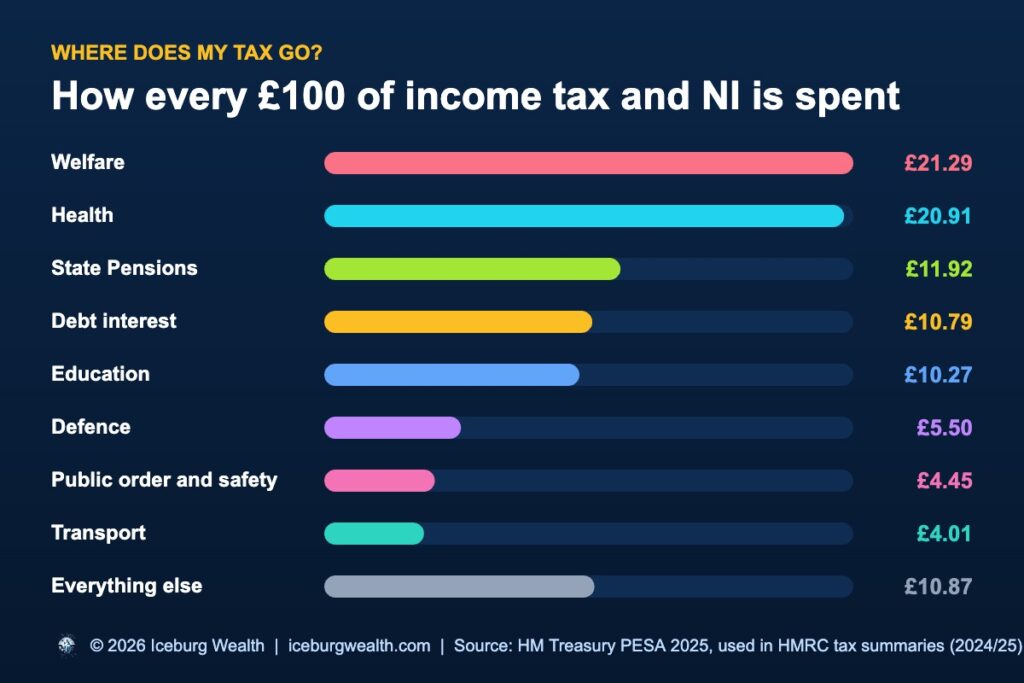
Welfare: 21.3%
Welfare was £246.1 billion. It covers benefits, tax credits, public sector pensions and support for families, sickness, disability and housing.
Health: 20.9%
Health spending, mostly the NHS, was £241.8 billion. In other words, about 21p of every £1 in the breakdown goes on health.
State Pensions: 11.9%
State Pensions cost £137.8 billion. HMRC shows them separately from welfare, so you can see how much goes on pensions alone.
National debt interest: 10.8%
Interest on government debt was £124.7 billion. That was more than the £118.7 billion spent on education, and almost double the defence budget.
Education: 10.3%
Education, from schools to universities, received £118.7 billion. It rounds out the five biggest areas.
Why debt interest takes such a big slice
Debt interest has become one of the largest costs in the budget. As national debt has passed £3 trillion and interest rates have risen, the cost of servicing that debt has climbed.
Our UK national debt history chart shows how the debt has grown since 1993. Meanwhile, our UK interest rate history chart shows why borrowing has become more expensive.
Where does tax go when spending is bigger than tax?
Income tax and National Insurance are the biggest taxes, but they do not pay for everything. In 2024/25 they raised about £310 billion and £174 billion, around 43% of all government receipts.
However, total spending was £1,292 billion, which was £153 billion more than the government took in. That gap is filled by borrowing, which adds to the national debt and to future interest bills.
What this means for you in 2026
Seeing where tax goes can make your payslip feel very different. To see exactly what you take home, try our take home pay calculator. For ideas on keeping more of your money, read our guide to paying less tax legally.
To see how your pay compares with everyone else, try our how rich am I calculator.
You can also see how tax rates have changed over time in our UK income tax history chart, and view your own breakdown in your HMRC Annual Tax Summary. The method behind the figures is explained by HM Treasury on GOV.UK.
Where does tax go? FAQs
Welfare and health take the biggest shares. In 2024/25, welfare was 21.3% of the spending used in HMRC tax summaries and health was 20.9%, so together they made up over two fifths.
About 21p in every £1, based on health making up 20.9% of the spending in HMRC’s tax summary breakdown for 2024/25.
National debt interest was £124.7 billion in 2024/25, or 10.8% of the spending in HMRC’s breakdown. That was more than the £118.7 billion spent on education.
No. Like HMRC’s own tax summaries, the calculator only covers income tax and National Insurance, because HMRC does not know what each person spends.
They come from the HM Treasury breakdown used in HMRC Annual Tax Summaries, based on Public Expenditure Statistical Analyses (PESA) for 2024/25, with State Pension figures from the Office for Budget Responsibility.
Yes. If you pay tax through PAYE or Self Assessment, you can view your Annual Tax Summary in your HMRC personal tax account on GOV.UK.