Balance the Books is a free prime minister game for anyone in the UK. You get five Budgets, a run of crises and one general election at the end. Can you fix the public finances and still win the vote?
You're the Prime Minister. Five Budgets, one election. Can you fix Britain's finances and still win?
Ready to run the country?
Tap to load the game
How to play the prime minister game
Each game takes about ten minutes. Better still, every play is different, because the crises are shuffled each time.
Step 1: Start the prime minister game at Number 10
First, add your name and pick a party colour. Then step inside. You start from roughly where the UK is today, using rounded figures from the Office for Budget Responsibility (OBR).
Step 2: Deal with the breaking news
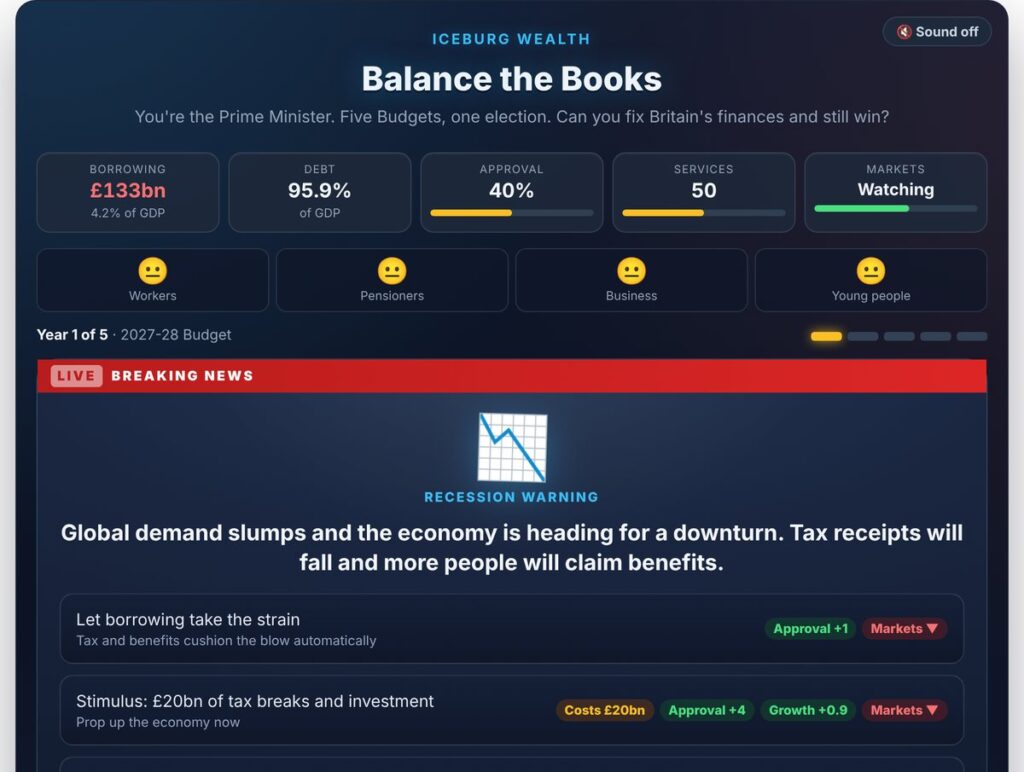
Every year opens with a crisis or a curveball. It might be a recession, an energy price shock, a cyber attack or a surprise tax windfall. Each choice shows what it costs in money, votes and public services.
Step 3: Set your Budget
Next, you set the Budget. You can move 13 taxes up or down, from income tax and VAT to stamp duty and inheritance tax. You also decide how much the NHS, schools, defence, councils and other services get, and what happens to the state pension.
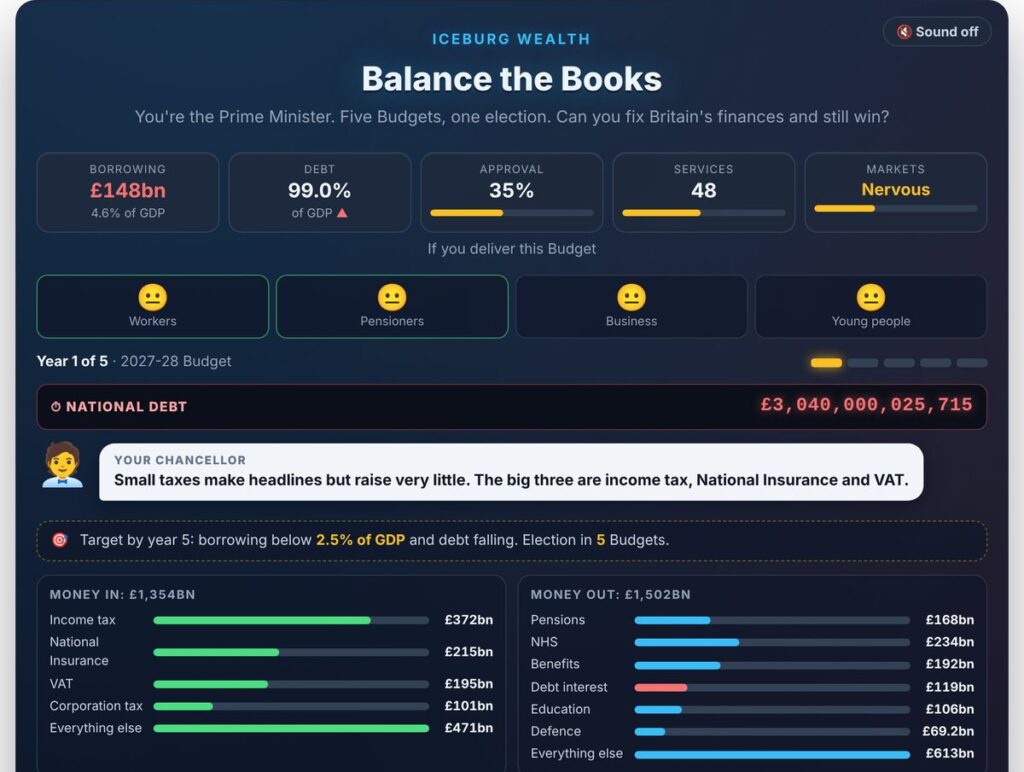
As you move each slider, a live dashboard shows borrowing, debt, approval, public services and how nervous the markets are. Meanwhile, your Chancellor chips in with advice. Four groups of voters react too: workers, pensioners, business and young people.
Step 4: Survive Prime Minister’s Questions
After each Budget, the Leader of the Opposition gets a question in. You have 12 seconds to pick your answer. Get it right and your benches roar. Get it wrong and the House erupts.
Step 5: Face the voters on election night
Finally, after five Budgets, the polls close. The exit poll lands, the seats come in and you find out if you won. You then get a legacy score out of 100, up to 8 badges and a few lessons based on how you played.
Where the UK government gets its money
Most of us never see the national accounts. However, the game shows you live where the money comes in and where it goes out.
Income tax, National Insurance and VAT are the big three. Together, they raise well over half of all government receipts. That’s why almost every big Budget decision comes back to them.
The game uses HMRC’s estimates of what tax changes raise to work out each choice. For example, 1p on the basic rate of income tax raises about £8bn a year. In comparison, one point on VAT raises about £9bn, while one point on employer National Insurance raises about £11bn.
Why balancing the budget is so hard in the prime minister game
On paper, fixing the deficit sounds simple. Raise taxes, cut spending, job done. In practice, every lever has a catch.
Debt interest eats into everything
In 2025/26, the government spent more on debt interest than on the day to day defence budget. In the prime minister game, every pound of extra borrowing adds to that bill in the years ahead.
Some tax rises raise less than you think
Higher tax rates don’t always mean more money. For instance, HMRC estimates that a big rise in the higher rate of capital gains tax would actually raise less, because people hold on to their assets instead of selling. The game copies this, so watch out.
Voters feel every choice
On top of that, tax rises and spending cuts are unpopular. Yet if you leave services short of money, they get worse and voters notice that too. As a result, there’s no perfect answer, only trade offs.
The bond markets are watching
Borrow too much and investors get nervous. If they panic, the interest rate on government debt jumps and you have a crisis on your hands.
Tips for winning the prime minister game
Don’t starve public services
Demand for the NHS and social care keeps rising. So if you only keep their budgets as planned, services slowly get worse. A small boost each year helps keep voters on side.
Be careful with unfunded tax cuts
Tax cuts are popular. However, big cuts while borrowing is high can spook the markets. If that happens, your debt interest bill rises and you lose room for everything else.
Keep your answers honest at PMQs
Jokes and attacks can land well, but they backfire more often. Over five years, explaining the trade off honestly is usually the safest bet.
How the figures in the prime minister game are worked out
The starting point uses rounded figures from the OBR’s October 2026 Economic and fiscal outlook. That forecast puts borrowing at £133bn in 2026/27, or 4.2% of GDP, with debt at around 96% of GDP.
Tax rates start where they are today. So the basic rate of income tax is 20%, VAT is 20% and corporation tax is 25%. Everything else, including how voters and markets react, is a simplified model built for the game. In other words, it’s a learning tool, not a forecast or a political view.
What the prime minister game teaches you about your own money
Running a country isn’t the same as running a household. Still, a few lessons carry over. Borrowing costs build up, small spends add up and every budget comes down to choices.
If you want to see how today’s tax rates hit your own pay, try the take home pay calculator. And if you’d rather manage one pay packet than a whole country, have a go at Survive the Month, our budgeting game. You’ll find both, plus more, in our money games and free financial tools.
Play more free money games
Fancy something closer to home? Try making your own pay last a month, or break out of debt against the clock. You can also see all money games here.
Want the real numbers behind the game? Watch the world debt clock, then read our UK economy guide and UK tax guide.