
Free Dividend Portfolio Tracker
Watching your dividend income grow is one of the best parts of investing. This free dividend portfolio tracker keeps all your holdings in one place and shows your yield, yield on cost and income by month.
Free Excel file. Works in Excel, Google Sheets and Numbers. On a phone you may need the free Excel, Numbers or Google Sheets app.
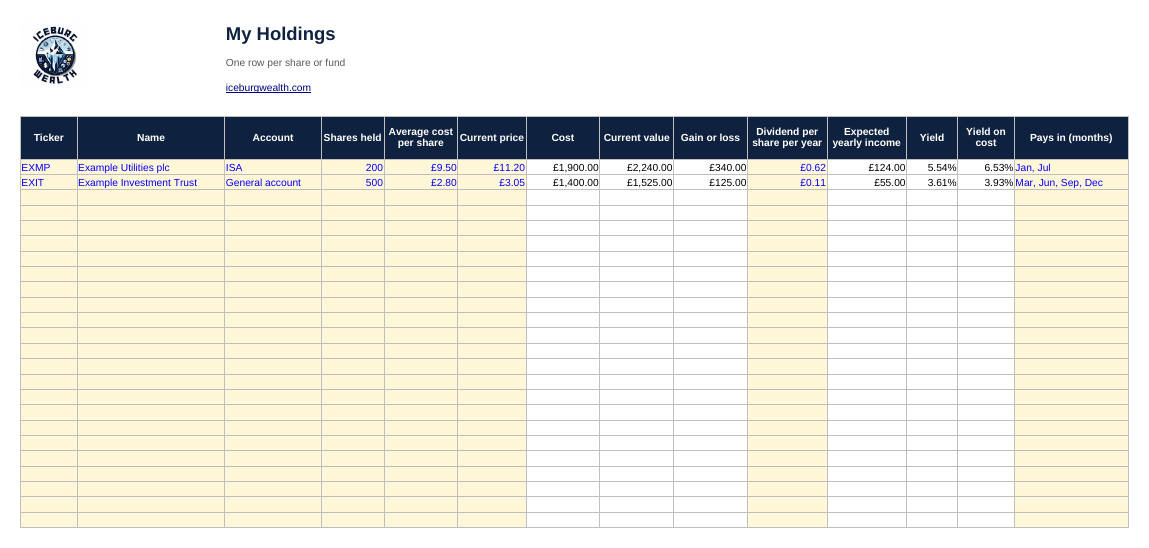
What’s in the Dividend Portfolio Tracker
📈 Holdings
Up to 40 shares or funds with cost, value, gain, expected yearly income, yield and yield on cost.
🗓️ Dividend log
Record each payment as it lands. The tax year and month fill in automatically.
💷 Summary
Dividends by month and by account, with a chart and a rough tax estimate for anything held outside an ISA.
Dividend Tax in Brief
Dividends inside an ISA or a pension are free of UK tax. Outside them, the first £500 a year is tax free under the dividend allowance. Above that, you pay 10.75% as a basic rate taxpayer, 35.75% as a higher rate taxpayer and 39.35% as an additional rate taxpayer, according to GOV.UK. The dividend portfolio tracker gives you a rough estimate of this tax.
How to Use the Dividend Portfolio Tracker
You will need a list of your holdings from your broker, including what you paid and the number of shares or units you own.
Step 1: Download and Open the File
First, download the dividend portfolio tracker and open it in Excel, Google Sheets or Numbers.
Step 2: Add Your Holdings
Next, fill in the Holdings tab with each share or fund, the account it sits in, what you paid, today’s price and the expected yearly dividend per share. The tracker works out your value, gain, yield and yield on cost.
Step 3: Log Each Dividend as It Arrives
Then record every payment on the Dividend log tab. The tax year and month fill in automatically from the date you enter.
Step 4: Check Your Summary
Finally, open the Summary tab to see your income by month and by account. It is a great way to watch your passive income build over time.
Yield vs Yield on Cost Explained
Yield is the yearly dividend divided by today’s share price. Yield on cost is the yearly dividend divided by the price you actually paid.
For example, say you bought a share at £10 and it pays 50p a year. Your yield on cost is 5%. If the price later rises to £12.50, the current yield falls to 4%, but your yield on cost stays at 5%. And if the company raises its dividend, your yield on cost goes up too. That is why dividend growth investors love this number, and why the dividend portfolio tracker shows both.
Why Your Account Type Matters
Where you hold your shares changes how much you keep. Dividends inside a stocks and shares ISA or a pension are free of UK tax. You can put up to £20,000 a year into ISAs.
Outside an ISA or pension, any dividends above the £500 allowance are taxed. So the tracker splits your income by account, which makes it easy to see how much is exposed to tax.
Related tools and guides: What Is Yield on Cost? and How to Invest for Income.
Dividend Portfolio Tracker FAQs
How Do I Record Reinvested Dividends?
Log the dividend on the Dividend log tab as normal. Then add the extra shares it bought to your holding, so your income and share count both stay accurate.
Can I Track Funds and Investment Trusts?
Yes. Any holding that pays an income works, including funds, ETFs and investment trusts. Simply use the yearly distribution per unit instead of a dividend per share.
How Often Should I Update Prices?
Once a month is plenty. Dividend investing is a long game, so there is no need to check prices every day.
Does It Work Out My Dividend Tax Exactly?
No. It gives a rough estimate for anything outside an ISA or pension. Your real bill depends on your other income, so check your Self Assessment or speak to an accountant.
Ready to get started?
Download it free, fill in your own figures and let the spreadsheet do the maths.
New to income investing? Start with our guide to dividend growth investing, then see our UK dividend growth stocks to watch. You can also try our dividend income calculator.
This spreadsheet is general information only and is not financial or tax advice. Tax rules can change and depend on your circumstances, so check GOV.UK or speak to an accountant before relying on it. Correct for the 2026/27 tax year, updated October 2026.